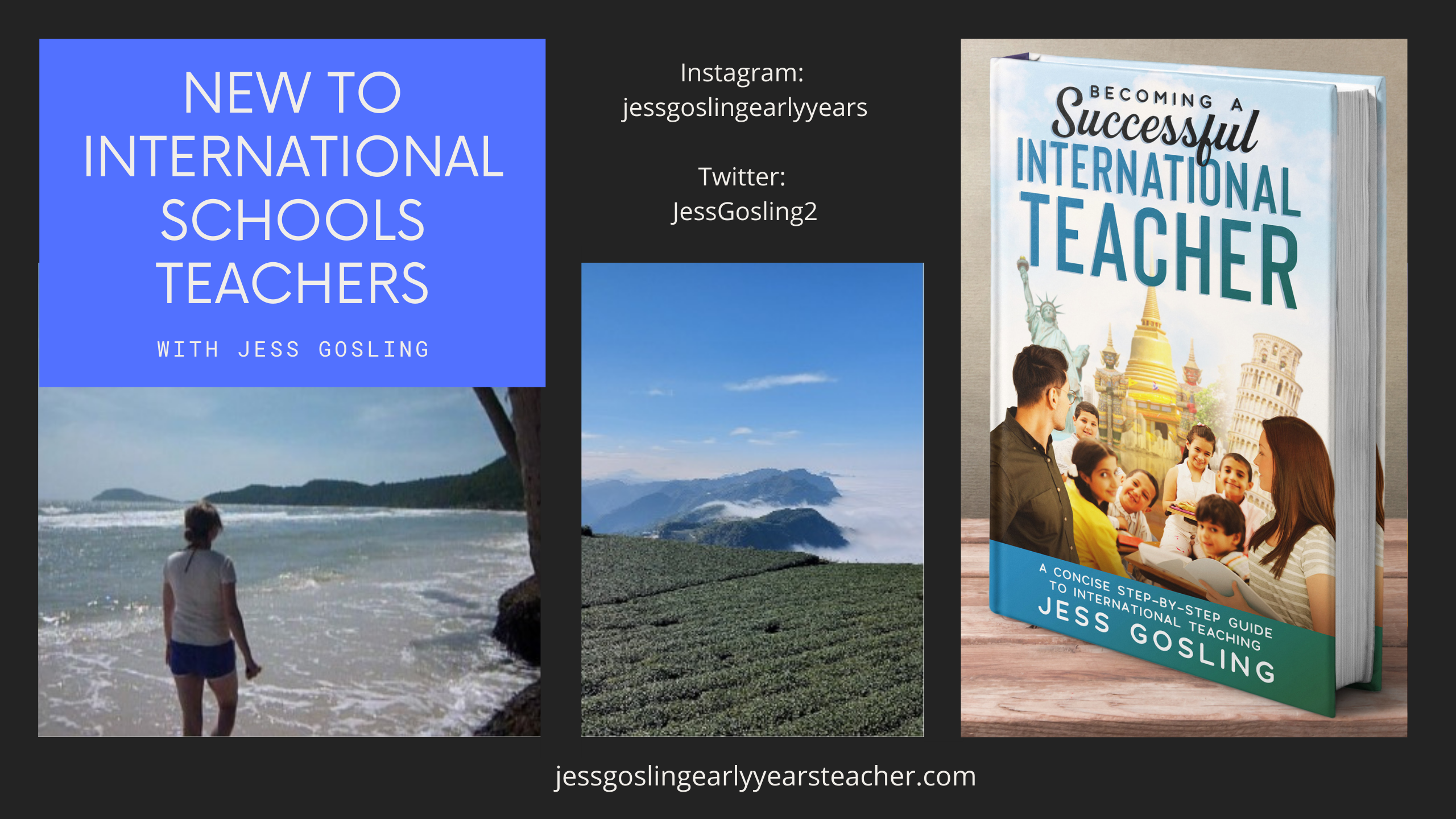

I chose the image above for this blog, as well as my website, as I believe deeply that by even investigating the idea of searching for international teaching jobs, you have done something great. You have looked for a life whereby adventure is at the forefront when teaching overseas. Many people do not feel that changing their life will lead to greater fulfilment, and they are very comfortable where they are. We will talk at length about this in further blogs. However, if you are reading this right now I am good to presume that you are curious about teaching internationally, living in a different country, and exploring the abundant different global opportunities this presents.
In my latest blog series, I will be quoting directly from my book, Becoming a Successful International Teacher (2021) as well as adding my anecdotes and thoughts. Use these blogs as a starting point, but research deeply and widely. My book discusses in greater depth each area, but there are also teachers to follow on Instagram/Twitter, Facebook groups to connect to, magazines and other publications. In due course, I will share them.
So, to begin with, I wrote in my Preface that you must be qualified to work at the most established international schools. Initially, most teachers work at Entry-level international teaching jobs. What I mean by this is that you may not be employed in the same level of a ‘scale’ that you may currently be on, or with any leadership stipend. For your first role, it is likely you will need to look at schools in less desirable locations to get your ‘foot on the ladder’, so to speak. Some schools accept teachers without a recognised qualification, but these are not so abundant. By being a qualified teacher, in the private international school context, I mean to have an “…internationally-recognised qualification gained in or from the UK, or the equivalent qualification such as a US State Licence…These qualifications may be gained worldwide; however, they need to be accredited by a ‘western’ institution or university”(2021, p.9 and p.15). The roles I discuss are not Teaching English as a Foreign Language (TEFL) positions but effectively working in a school which matches your home country, at least in curriculum, where you are already qualified to work as a teacher.
If you are looking to teach in the UK, in state sector or private schools, teachers from some other countries with their respective country qualifications can apply for Qualified Teacher Status (QTS) which will enable you to work in the UK, then with this licence work overseas. So this could be considered a route into teaching internationally. Teachers can work up to 4 years in the UK without QTS. More details here: https://www.gov.uk/government/publications/apply-for-qualified-teacher-status-qts-if-you-teach-outside-the-uk/routes-to-qualified-teacher-status-qts-for-teachers-and-those-with-teaching-experience-outside-the-uk#applyservice
If you are already a teacher in your home country and have studied in the UK, you may be able to apply for Assessment Only QTS. Information from the site above explains:
To apply for assessment only QTS, you do not need a formal teacher training qualification.
However, you must have:
- a minimum of 2 years’ teaching experience
- a first (bachelor’s) degree from a UK or non-UK university
- an English language qualification that is the same standard as a grade 4 GCSE (General Certificate of Secondary Education)
- a maths qualification that is the same standard as a grade 4 GCSE
- to teach children aged 3 to 11 in primary school, a physics, chemistry or biology (science) qualification that is the same standard as a grade 4 GCSE
If your qualifications come from a non-UK institution, your assessment only teacher training provider may want to see a statement of comparability from UK ENIC, the UK national agency for international qualifications and skills, showing how they compare to UK qualifications.
If you are already teaching abroad, without a qualification, you can apply to complete iQTS (international QTS) via the TES institute as well as universities. Note the difference between the PGCE (academic) and QTS (Qualified Teacher Status). Many international schools will not accept the PGCE or iPGCE with QTS. However, as QTS qualifies you to teach (as a licence) this can be accepted without a PGCE.
I hope this helps ascertain whether your qualifications will suffice for an international school. A second note to add here, and I particularly stress this with British international schools, experience teaching the curriculum is highly valued. Even more so if you have had a minimum of two years teaching in your home country. Schools will believe that you are abreast of developments/pedagogy and can share recent practice with them. Furthermore, schools may value that you have taught their curriculum in a country with inspections and very likely, demands to teach at a challenging level.
That’s all for now! Tomorrow I will post a valuable question that any qualified teacher looking to relocate must ask,
Will I be comfortable working abroad?
 New to International Teaching with Jess Gosling