
The Offer Part 2: Considerations before accepting the international teaching job offer

In my previous blog I mentioned a few considerations in terms of the job offer. This blog will be an expansion of this, as really in terms of your move, this is the biggest decision you will make!

This will be my last blog until spring, as offers begin to come now and will continue for a few months. My next blog will be all about preparations.

Consider the package as a WHOLE

It is important to add up all the benefits of the package in addition to the salary, especially in terms of comparisons between different job offers. This is especially relevant if you have accompanying dependants. If health insurance, flights, and/or full/subsidised school fees are included, your overall package will substantially increase. Housing allowance should be carefully considered and compared to current rental prices (and from experience, check multiple websites and do not believe assertions that you can get cheaper rental once there!) Some schools also offer free lunches and transport, which are also a monetary benefit as well as a relocation/repatriation allowance.

When considering your salary figure, this will be presented to you as gross. Investigate your likely taxes, HR should be able to support with this.

Understand the school and country

Make sure the school aligns with your vision and the country in which you feel your values match. That way, it is likely teachers you will work with will also follow the school ethos. Being on the same page will enable you to establish relationships with like minded teachers (Gosling, 2021). If you have a child/ren investigate as much as you can about the education offer.

Ensure where you have chosen to both live and work suits your demographic. For example, those with young children often look for a safe environment with an abundance of activities. As a young, single, teacher, you will likely want to prioritise being near a transport hub with great restaurants and nightlife (Gosling, 2021).

Some schools offer greater support to their teachers with wellbeing programmes and more realistic expectations of workload than others (wouldn’t a current list of these be wonderful?!). As you consider a school, check their website for wellbeing initiatives and seek out current or ex-teachers’ opinions (Gosling,2021).

Prior to accepting a position, it is worthwhile looking into the expat communities within the location you are considering. Some countries, such as Singapore and Bangkok, have thriveing expat communities with a range of activities and support (Gosling, 2021). Search for your favourite activities to see if they are offered in your host country.

However…

It is important to note that every school reflects the staff, management, and overall community, at any given time. Unfortunately, staff and situations in international schools usually change frequently. A school can be considered highly desirable one year to be panned the following year! (Gosling, 2021)

A personal note

We are ultimately all looking for somewhere we, and our significant others, can be happy. A happy school for me is one where staff feel they are compensated enough and they enjoy a good work/life balance. They feel respected and listened to. The ones that shout the loudest are not the only ones listened to, and presenting new ideas/challenging initiatives is encouraged by SLT. The feeling within the school should be positive for both students and staff.

Ways I can help you:

Connect via LinkedIn http://www.linkedin.com/in/jess-gosling. I share my blogs and relevant international teaching articles/resources here.

I like to contribute to X @jessgosling2

For photos of the travelling teacher, check Instagram @internationalteachertravel

Join my friendly Facebook group https://www.facebook.com/groups/newtointernationalschoolteachers/

For more information, check my website: http://www.jessgoslingearlyyearsteacher.com

Purchase my book,

Gosling J. (2021), Becoming a Successful International Teacher. DLA Press, Taipei.

The Teaching Job Offer: What should you expect?

This blog focus is the offer and contract.

As many international teachers are attending job fairs or receiving offers through applications at this time, it is important to know what should be part of your international teaching contract.

The contracts can vary from school to school, however you can expect:

  1. A full year contract, typically August-August, September-September. Check the dates carefully to ensure this. A teacher’s salary should be spread evenly over 12 months, with each month fully paid.
  2. Working days and PD clearly stipulated, as are your work hours. The school may expect meetings and extra activities outside of school, so this should be queried if it is a concern. Additionally, your contact hours are often not stated, so check these to ensure you have adequate PPA.
  3. A clear salary figure (with the possibility of being placed on a scale). This may be subject to tax (so understand both the Gross and Net). It may be open to negotiation if you are not provided a salary from a published scale. Negotiating is advisable, particularly if you believe the salary is on the low side after completing research on teaching salaries in the region, or if you are a highly experienced teacher (Gosling, 2021).
  4. Tuition for dependents can be included or partially included. Most schools cover tuition for up to two children. The cost of tuition added to your package can increase its value significantly (Gosling, 2021). Ensure you understand whether or not you will pay tax on this benefit, as fees can be high.

You can also expect, OUTSIDE of Europe:

  1. Full payment or a contribution to private health insurance. This can vary to only include the teacher or teacher plus dependants. Check the level of cover carefully and clarify any issues you may foresee. If you have a pre-existing medical condition, be upfront! Often these are covered (Gosling, 2021). If it is important to you, check dental insurance coverage also.
  2. Housing allowance should be provided in all countries outside of Europe. The amount can vary wildly, for example, one contract I had covered half my rent of a two-bed apartment, whilst another covered both my three-bedroom penthouse plus all bills. In addition, some countries demand large deposits (notably Korea and Japan), which your school may provide you with (Gosling, 2021).
  3. Many schools offer a beginning and end of contract flight for you and your dependants. The ‘better’ packages will offer flights every year (Gosling, 2021). Check if they offer the flights to regional airports or only one home city (such as the capital).
  4. Schools can offer a relocation and repatriation package as a specified lump sum. A relocation allowance financially supports teachers to ship or to purchase household goods once arrived. The remuneration for this will vary on whether your family includes a partner and children. Similarly, the repatriation package can be used when you leave for shipping or associated costs (Gosling, 2021). In several schools I received this sum on arrival, in another I had to wait until school started.
  5. A loan can be provided by the school to help with set up costs. The school will offer this either immediately or within a short while of arrival. These are usually interest-free and a portion of the loan is deducted from your monthly salary.
  6. A ’13th’ month salary is a clear benefit. This is paid every year if you complete the entire school year. This is approximately the amount you would receive per year as a pension (Gosling, 2021).

When calculating your salary, be sure to add together all of these benefits that create the package. Check websites such as ‘numbeo’ to compare the cost of living with home countries such as your home country. Once you work out the figures, you should be able to decide how much you would need to live on and how much you could save (Gosling, 2021).

Ways I can help you:

Connect via LinkedIn http://www.linkedin.com/in/jess-gosling. I share my blogs and relevant international teaching articles/resources here.

I like to contribute to X @jessgosling2

For photos of the travelling teacher, check Instagram @internationalteachertravel

Join my friendly Facebook group https://www.facebook.com/groups/newtointernationalschoolteachers/

For more information, check my website: http://www.jessgoslingearlyyearsteacher.com

Purchase my book,

Gosling (2021), Becoming a Successful International Teacher. DLA Press, Taipei.

Guest blogs : What to expect from induction and how to settle

To begin the New Year I am including two guest blogs from Sarah Tate of TeacherRecruit. She interviewed me just before Christmas and our ideas are combined in these blogs.

I hope you find them useful.

https://www.teacherrecruit.com/blog/MjE/what-to-expect-when-you-arrive-at-your-new-school/


https://www.teacherrecruit.com/blog/MjI/the-importance-of-effective-induction-for-international-teachers/

International Teacher Recruitment: Interviews

So your application was successful and you are on to the next step – the interview.

In this blog I will outline what an interview may involve and a few tips to support you. To read more about international school teaching jobs interviews, check my guide, ‘The Application Process’. In this chapter I speak about recruitment fairs, school tours and more. Here I will talk about just the basic interview. All quotes used in this blog are taken from my guide.

First Steps

So you may or may not have been refreshing your inbox during this cycle, but be aware, you are not alone in this if you do! Your first feeling when seeing the email, should this have been an application for a school you really wanted, will likely be elation, but pretty soon worry/fear my creep in.

Upon receipt of the email reply politely and promptly to accept, or respectfully request a different time. Do not worry if you need to do this, as schools know you need to honour work commitments. Don’t be afraid to ask any further questions about the interview here (format, who will be leading, etc.).

Your interview will likely be online. If they do request that you to attend a face-to-face interview, it it is important to you check whether transportation/hotel will be re-imbursed.

Preparation

Bring out all your old research notes that you made when researching the school and print out your application. Read over these. Check if there have been any SM school updates, as knowing about current events shows you are interested.

Format

With an online interviewing, you will likely have at least two interviews. The first can be called a quick ‘chat’, but this is actually a check to see if you are suitable, so prepare well! The second interview may be directly with the principal or involve the team you will work with. A final interview (which may well be the third) is likely to be by the head of the school. More recently, well-established schools tend to have a first screening interview, where you answer questions via a computer program. These questions are often sent to you first.

Tips

“Have a few questions prepared to show that you have researched the school well. Further, during the interview you can have a list of key words/comments you wish to mention within view (placed at the left or right of the screen so you do not need to look down.” (2021, p.64)

Smile, and “ensure that you sell yourself, as you would do a CV…look professional and dress exactly as you would in a face-to-face interview” (2021, p.64)

Look into the STAR method for constructing your replies to questions – you must evidence the change you have made and how it impacted learners. You mustn’t simply list all your accomplishments but weave supporting evidence into you answers.

Questions you could be asked at interview

  1. Tell me about your career to date
  2. Why do you want to work at our school?
  3. Tell me about your best lesson
  4. What can you bring to our school?
  5. How do you support learners with additional needs?

“In interview, try to remain calm when asked questions and give yourself time to think. If you are unsure what you are being asked, or need more time, ask the interviewer to repeat the question or rephrase it.” (2021, p.65)

Questions to ask at interview

Here are a small selection of ideas for what you may ask:

  1. What is the current focus of the school?
  2. What are the standards of behaviour?
  3. What is Professional Development in your school?
  4. What are the demographics of the school and the language background of pupils and staff? (especially relevant if you have children you wish to attend)
  5. What are the requirements in terms of extra-curricular activities, meetings and weekend work?

When in interview, remember this is a discussion. You need to be sure this is a school you want to be working for and your interview is the place to find out if you are good match.

And finally – “Show enthusiasm for information the interviewer shares and you can ask further questions to clarify what they share with you.” (2021, p.66)

Ways to connect with me:

Via LinkedIn http://www.linkedin.com/in/jess-gosling

Via X @jessgosling2

Via Instagram @internationalteachertravel

Via Facebook https://www.facebook.com/groups/newtointernationalschoolteachers/

Website: http://www.jessgoslingearlyyearsteacher.com

Purchase my book,

Gosling (2021), Becoming a Successful International Teacher. DLA Press, Taipei.

Cover Letter: do’s and dont’s

Having crafted the perfect CV (see my previous blog) or filled in the application form, the next stage in completing an application is the cover letter.

Do not be fooled thinking this is just a short introduction for the CV.

The cover letter is extremely important when demonstrating your interest and suitability for the school. Make sure each letter is tailored to the school and role in question and check it several times for any errors (especially in terms of a correctly named school!)

I have a section of my guide where I cover these letters in depth, including examples, however in this blog I will outline some do’s and dont’s.

Do

  1. Review the school mission/advert and job spec and weave this into the cover letter (prove why they should hire you!)
  2. Understand what the school are currently trying to improve and tell them how you will support this (a good place to look for deficits is the most recent accreditation review)
  3. Be succinct – maximum 2 pages!
  4. Give concrete examples of your work
  5. Relate your prior experiences (EAL/private schools) to the current school, emphasising how you succeeded raising attainment

Don’t

  1. Simply copy over the whole of an old cover letter to the next school. You are likely to have errors in terms of the name (agh!) or it will not be as closely matched to the school. However, as I detail below, you can take sections and adapt them
  2. List everything from your CV – this is your chance to pull out what the school want in a candidate and provide evidence that you have it
  3. Use long, rambling paragraphs.
  4. Send it out without spell/grammar check and at least one other pair of eyes checking over the letter
  5. Combine a letter as a couple. Make two separate letters showing that you are two strong teachers in your own right

Make sure that you keep a record of each cover letter to review should you get to the interview – it’s likely some questions may be based around this. I have this letter printed and available when interviewed.

A spreadsheet or similar is ideal to keep a record of all your applications. It is interesting to note which were more successful in achieving an interview. In the past, I have looked over these cover letters and used elements of the letter in future applications.

Remember, “…if you are a first-time international teacher, it is highly likely that you will need to apply to many schools before getting an interview. If you are rejected by schools, politely request feedback. Use this feedback to adapt subsequent applications.” (Gosling, 2021, p.60).

Next week – Interviews!

Ways to connect with me:

Via LinkedIn http://www.linkedin.com/in/jess-gosling

Via X @jessgosling2

Via Instagram @internationalteachertravel

Via Facebook https://www.facebook.com/groups/newtointernationalschoolteachers/

Website: http://www.jessgoslingearlyyearsteacher.com

Purchase my book,

Gosling (2021), Becoming a Successful International Teacher. DLA Press, Taipei.
New Pathways in Recruitment Teacher Recruit: the App

Last week, I was fortunate to come across a LinkedIn post from Sarah Tate explaining the launch of her new recruitment app, Teacher Recruit at FOBISIA Bangkok.

As ever curious, I messaged her to find out more. Later the same week, we held a discussion in which she provided more details about this innovative app she created with her business partners to support international teachers and schools. As a British parent with children in international schools for over a decade, Sarah was aware of the costs incurred by schools in order to find suitable teachers. She hoped that developing an app to reduce this cost, could be one way to support schools to reduce their costs to parents.

Over a year of extensive market research, Sarah and her team identified a gap in the international teacher hiring market and worked hard to design and refine their product. Their app simplifies and streamlines the hiring process for both international teachers and schools. They identified two main areas in which Teacher Recruit could help:

1. Each international school and/or recruiter requires a bespoke cover letter and application. This is time-consuming especially as multiple applications are often necessary. Even more frustrating is that some of the applications may never be considered by a school. 

2. For Millennials and Gen Z teachers in particular, scrolling through endless job boards is highly off-putting.  

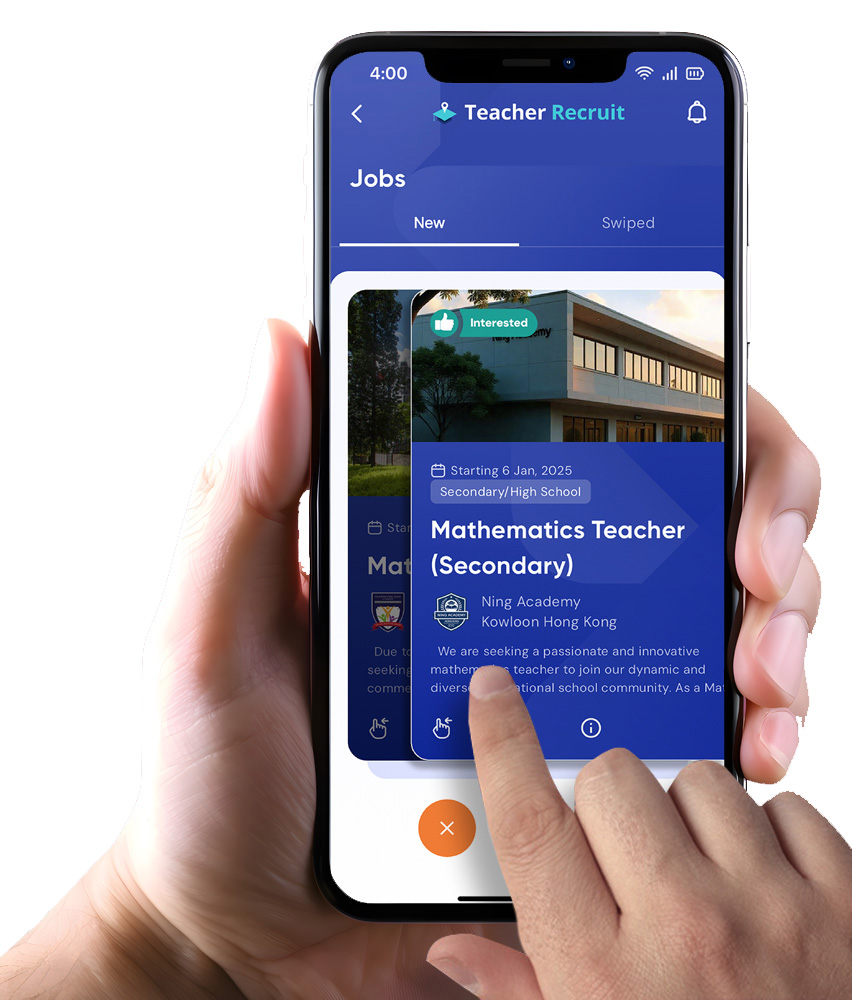
Keen to find a solution, the Teacher Recruit app was developed. We all know about ‘swipe right’ in dating apps, but what if choosing a new teaching job was as easy as this? 

The app requires the teacher to upload their profile once, in which they list their experience, the role sought, and their desired location. Once complete, a teacher can view schools that show up on their feed that match their profile. If the roles are interesting, a teacher can swipe. If not, they can simply scroll on. As schools receive only candidates who match their requirements, the hiring process is streamlined as they do not receive irrelevant replies. 

What happens after ‘swiping right’?

The algorithm filters the teacher’s profile through to the school. The teacher appears in the school’s feed as an ‘interested candidate’. If there is a ‘good match’, HR can progress the application to the next stage, which the school decides. This could involve a chat, an interview or sharing more information.

Do teachers pay a fee?

They do not. Instead, the schools pay a yearly fee to add and remove as many jobs as they want over the year. Sarah explained this rate is around 10 percent of the cost of standard hiring companies.

Can any nationality apply?

Yes. Currently, the UK, America, Australia, and Canada are suffering a teacher shortage. These countries historically supplied teachers to international schools. However, as Teacher Recruit works with global teachers, they can expand the ‘pool’ of well-qualified teachers available to schools worldwide. This initiative strongly supports DEIJ in opening opportunities to local qualified teachers and teachers from other countries.

What coverage do Teacher Recruit have?

Teacher Recruit has a global support team based in Hong Kong, Malaysia, Dubai, and China, plus offices in the UK and Singapore. The team provides personalised support and has a deep understanding of local and global recruitment landscapes.

How can teachers be sure the schools are legit?

Sarah works with tier 1 schools, and the company is an affiliate of British Schools in the Middle East (BSME), the Council of British International Schools (COBIS), and the Federation of British International Schools in Asia (FOBISIA). Teacher Recruit allows teachers to filter for member schools that meet these high standards.

How do I sign up?

Simply download the app and start scrolling!

Contact details for Teacher Recruit

Website 

To download the app:

Google Play                 Apple Store

Action for Happiness: Bringing positivity back into your life

I have taken a break from my usual recruitment break to share an excellent resource with you.

Having taken this time away from working in schools, I have been surrounded by a new group of friends (not teachers) and I have noticed, more than anything else, how positive they are.

Yet when I met a group of teachers within this same community, the conversation quickly developed into negativity and unhappiness. This does not just reflect my current community, I have identified this to be the case in schools in which I have worked.

Moving abroad is amazing. But if the job is just as stressful and demanding as home, which it very often is, you need to find ways of coping. Beyond a school-issued the ‘free donut’ , coffee machine (although I did love that initiative!) or yoga sessions to raise staff well-being.

So what do I suggest to support personal happiness?

As I transitioned from working at schools in June, I began working on my personal development. I came across Mo Gawdat’s ‘Solve for Happy’. After I read this, I began to follow his podcast, ‘Slo Mo’.

On this podcast Mark Williamson was featured. In his younger years, Mark worked in a very busy, ‘full on’ environment, where he was doing well. However, he recognised he needed to change his way of working due to health issues, and felt a strong urge to help others. He developed the charity, ‘Action for Happiness’.

You can follow a 10-day positivity plan, however what I found even more interesting was the training he provides for individuals to become a happiness coach. Once trained, a coach works in the community to have weekly check-ins with a group. The groups offer the chance to meet others near you who care about happiness, learn more about how to live a happy life and take action that makes a meaningful life. Each month the group explores one of the 10 Keys to Happier Living, evidence-based ways to create a happier and more meaningful life. (Actionforhappiness.org).

What I love about the idea of these groups is that they build community, perhaps with a mix of individuals both inside and outside of teaching. It is an opportunity to meet like-minded people locally, explore the monthly theme, and set personal actions to take forward in your own life.

If you live internationally you only need a partner to set one up.

Consider the change this could support could offer for teachers.

The next time you hear a conversation turning negative, or you identify others’ around you struggling with happiness, perhaps this is something you could suggest?

Building community as an international teacher is one of the best ways to settle and adjust. How about building your community based in kindness, happiness and care?

“Supporting your community in which you live can be hugely rewarding and it is a way you can make a difference.” (Becoming a Successful International Teacher, 2021, p.99)

Ways to connect with me:

Via LinkedIn http://www.linkedin.com/in/jess-gosling

Via X @jessgosling2

Via Instagram @internationalteachertravel

Via Facebook https://www.facebook.com/groups/newtointernationalschoolteachers/

Website: http://www.jessgoslingearlyyearsteacher.com

Purchase my book here.

Getting Recruited at an International School: Spotlight on True Teaching

Nadine Tyro, Director of True Teaching

In its relationship with clients and educators, True Teaching embodies ethical and honest practices in its effort to ensure dedicated Educators are placed in front of classrooms everywhere. True Teaching aims to improve the quality of education in schools around the world by putting the best Educators in schools that match their aspirations, values and pedagogical beliefs. This is achieved by establishing relationships, between, True Teaching, its clients and candidates, based on integrity, and the expectation that those relationships will endure and deepen.” (https://www.trueteaching.com/about/)

What is a teacher recruitment agency?

When I explored teaching agencies in my book and researched opinions on the use of small/medium and large agencies, over larger websites such as TES, international teachers shared:

“…using an agency does give you a better chance of being placed in a reputable school, rather a school which has simply placed an advert on a job search page. The reason for this is that agencies often visit schools and therefore they connect with the management team and gain an understanding of how the school operates. Further, some agencies visit schools to ensure that the teachers and schools are a good ‘fit’” (Gosling, 2021, p.22)

True Teaching is a small agency, operating as a ‘free for teachers’ agency, not requiring either teacher or school to pay a registration fee. The school pays a fee only when a candidate is employed. Due to her wealth of experience in international schools, Nadine Tyro, the director, has built up trust within the schools she recruits for. Furthermore, she endeavours to find them the quality candidates they seek, as she understands their needs due to her background. She encourages a personal relationship with the hiring team, explaining that when she visits schools she will often share a cup of tea and take time to pinpoint their needs. Nadine shared that she is known to ‘go the extra mile’ for schools to find them just the right candidate.

I first came across the ‘Flying Squad’ initiative when writing my guide in 2021. The ‘Flying Squad’ temporarily places teachers in schools, typically covering long-term sickness or maternity leave. True Teaching also offers permanent international teaching and administrator contracts.

I spoke with Nadine as I was curious about what sets True Teaching apart from larger agencies such as Schrole and ISS. In some ways, True Teaching operates similarly to Schole, as she holds a large database of quality teachers in which schools can access and hire. Teachers also have access to her database of available positions. 

However, Nadine’s business philosophy differs a great deal from the larger agency. In this blog I will detail these differences and why you may wish to consider an agency such as True Teaching.

Ethics and Trust

True Teaching prides itself on being honest and ethical recruiters. They work only with ethical schools and organizations that provide and uphold appropriate working conditions, salary, and benefits packages.

Nadine made it clear that she knows the realities of working in international schools, as her career over many years has been in education, both in teaching and leadership, across several continents. Therefore she can present the realities of working in certain schools and countries, to fully prepare the candidate for the role. She offers advice, guidance, and training to candidates and clients to improve their chances of a successful outcome.

By connecting both a teacher with a matching school, Nadine builds loyalty with both. She explained that if she does receive a report from a teacher that shows a school does not match what they offer, True Teaching will no longer use the school.

Personal Touch

When applying through True Teaching your CV will be personally looked over by Nadine, who will begin to think about where you could be best matched. She prides herself in getting to know people, and in our short conversation, I could feel how she would be an excellent person to approach when considering a role in a new school.

Myth-busting

When I researched my book in 2021, I gathered data which showed that teachers were concerned that schools would provide a slightly adjusted salary to take into account an agent’s fee. Nadine assured me this is not the case, and in fact, most of the top-tier schools have a salary scale to which they must adhere.

What do candidates need to consider?

She shared that in particular for the short-term, ‘Flying Squad’ posts a more experienced international teacher is desired, as they are more likely to cope with teaching rather than being distracted/overwhelmed by differing cultural aspects. Being self-reliant for these contracts is vital as there may be very little time to induct you into the role.

For the longer-term placements, Nadine stresses a minimum of two years experience of in teaching is ideal. There can be issues with certain visas so Nadine keeps abreast of certain country requirements and can advise teachers on this. She also stresses that it is good to be aware of which countries require specific qualifications, again, this is something she can confidently advise on. She gave the example of the UAE and science-related degrees for teaching Science. In addition, for some countries university transcripts must match the requirements of the job role.

What key qualities do the best candidates have?

Nadine stressed that resilience is key. Being able to adapt to a new environment, at times very quickly such as the short-term ‘Flying Squad’, will certainly be a powerful characteristic to cope in a different environment. She also explained that for more experienced international teachers, showing commitment to staying at schools longer term, rather than moving every two years, allows you access to the higher tier schools. She emphasised that the cost for schools to invest in a new teacher is high, therefore schools often look for teachers who will stay beyond their first contract.

Next Steps

If you are beginning your international teaching journey or a few moves in, I recommend you contact Nadine to see how she can support your next move. She has many great schools, worldwide, on her books and seeking high-quality candidates to fulfil roles in this season.

How to connect with Nadine Tyro- True Teaching

If you have full teaching credentials, several years of experience in a home/international school, and are seeking a new adventure you can get in touch:

LinkedIn

Website

Email

Developing your CV: International Schools

Earlier this year I published a blog, “Preparing for International Schools: expanding your CV”, where the emphasis was on how to increase your chances at being hired at an international school.

In this blog, I offer more detail about your “bare-bones” CV where certainly for British Schools, you would be likely to cut and paste into their application forms. I have also experienced this in IB schools following the National Curriculum, however, I heard from Kelley Ridings that American curricula schools can still request a full CV or Resume. Smaller schools tend to not have the level of HR found in the larger, umbrella-group international schools, therefore they can also ask for a CV/Resume. All quotes for this blog come directly from my publication, Becoming a Successful International Teacher (2021), a value-for-money, in-depth guide to the application process through to settling.

Developing your CV

“When you create your CV, make sure the content and style matches what the school are looking for.” (p.54).

You are marketing yourself and your new school will be looking for people that ‘fit’, just as much as you are searching for a school you can be happy in. Work through each page on their website/newsletters/posts on Social Media as well as any Vision/Learning Charter they adhere to. Your CV should mirror and provide evidence that you support and follow a similar vision.

Include a photo or QR code? Personal information?

There is no requirement (unless specifically requested) to include any of the above. Personally, I do not include marital status, etc. here but instead in my cover letter, so the school is aware of potential dependants. A QR code can be a nice addition if you have space, but make sure there is a real reason for it. You can showcase something that highlights all your work in education, for example, such as a website. In terms of a personal photo, if you are not asked for one you do not need to provide one. Some teachers do include a photo to offer a ‘face’ to a name, but should you add one, make sure it is a professional shot.

Personal statement/career summary

This should be at the top of your CV and be a concise summary of your roles, strengths and aspirations. This is not a place to list each role, but instead would start with…’With over 10 years experience in…..’

Work experience first or education?

I have changed my mind about this several times! I always began with work experience, however, in later years with a Masters in Early Years I was advised to showcase this right at the top. So this really is dependent on what you want to showcase.

When listing qualifications/roles ensure they are reverse chronological, feature the school name/country and dates worked. If you have any gaps (such as maternity leave) state why. After detailing each role, provide statements of what you did (carefully matching to the job specification) and what the impact was for the school and children. As you reach roles further in your past, provide less detail and only write what may differ from your most recent roles.

Should I include training/voluntary work?

Short answer – yes! But make sure that training is relevant to your potential new role. I would argue all voluntary work is valuable, especially when it involves the wider community.

How to format the CV

The best CVs I have seen are produced on either Word or Canva.

They are not super jazzy, but informative and clear.

“By using clear formatting and sectioning on your CV, it will be easier to read, which is especially important if the school uses an Applicant Tracking System (ATS). As some schools recieve huge numbers of appplications, they must use this software to search for specific keywords and qualifications in order to ensure candidates match the job description” (p.55)

Hence the importance of carefully matching the job description/personal specification with your wording in your CV. You do not want to be rejected on this first step!

How should I send my CV?

To ensure that the format remains intact, use a PDF rather than a Word file or similar. In Canva you can download as PDF. If you are requested to use and apply with a particular format, make sure you follow the instruction.

Any final thoughts?

Re and re-read your CV! Ensure:

Correct tenses (previous positions are past tense, current position present)

Formatting is consistent throughout – check font size, any changes in font for certain headers are used on the whole document

Spellcheck more than once!

Have a friend check your CV/Resume

Limit your CV to ideally two, maximum 3 pages – referees can be included on a seperate document

Do you need further help?

You can watch CV clinics I created with Women Ed here and here.

You can view a recruitment webinar (with a Resume/CV discussion) created with fellow authors, Kelley Ridings and Amy Melton.

If you want me to help you develop your CV, or support you on your first job search, I offer these services.

Ways to connect with me:

Via LinkedIn http://www.linkedin.com/in/jess-gosling

Via X @jessgosling2

Via Instagram @internationalteachertravel

Via Facebook https://www.facebook.com/groups/newtointernationalschoolteachers/

Website: http://www.jessgoslingearlyyearsteacher.com

Purchase my book here.

The Application Process for International Schools: Finding a Good Fit

Finding a Good Fit. In my opinion, this is the most important aspect of the job hunt.

“As you research a school [in preparation for an application], ask yourself: is this a place where I would be happy to live and work for at least two years?” (Gosling, 2021, p.51)

Keep in mind your personal key considerations and ideas listed in Chapter 1 of Becoming a Successful International Teacher.

What to research

I share a detailed account in my book, but here a few ideas with example.

Find out everything you can about the school.

Check across social media including forums. Pull up their accreditation reports. Connect with previous/current teachers and ask them any questions which are important to you. However, be careful not to ask questions which could be used in interview, focus on instead the support offered, PPA time, staff ‘voice’, work/life balance, etc. Also see what parents say about the school.

Candidly use databases to research.

Examples include Teacher Horizons (free upon registering), ‘International School Advisor’ (some free elements), and International School Review (paid). Cross-reference reviews for authenticity and accuracy – remember this can give a one-sided viewpoint.

Research the Senior Leadership Team.

It can be difficult to really find out what the leaders are like until you work with them. However, if the website shares the leadership/staff team check representation of diversity, should this be important to you (I believe this is important to everyone!) You can use LinkedIn to specifically check how long staff have been in Leadership roles, it is not uncommon for international teachers to progress very quickly into management, which can impact on their depth of knowledge on teaching/learning.

Does the school/community support your vision?

You should aim to connect with a school that follows your ethics and working methods. For example, if you believe the school should be giving back to the local community, check that they offer voluntary experiences for the students. If you strongly support inquiry-based learning, ensure the school does too. If a particular sport/activity is important to you, check the community can or will provide this. Be aware that some schools have stringent views on what you can do outside of school. For example, if you are a writer/presenter, the contract may require that all that you produce is first checked with the school.

Visit the School.

I have stated this before, but will emphasise it again. The best way to help you get a ‘feel’ for the school to see if you are a good fit, is to go there and view it. Chatting with staff and seeing how students conduct themselves (are they happy?) will also aid your decision. Failing this, often schools offer zoom introductions for prospective parents and/or a video walk around on their website.

Ways to connect with me:

Via LinkedIn http://www.linkedin.com/in/jess-gosling

Via X @jessgosling2

Via Instagram @internationalteachertravel

Via Facebook https://www.facebook.com/groups/newtointernationalschoolteachers/

Website: http://www.jessgoslingearlyyearsteacher.com

Purchase my book here.