Settling in: Part 4 Building Communities

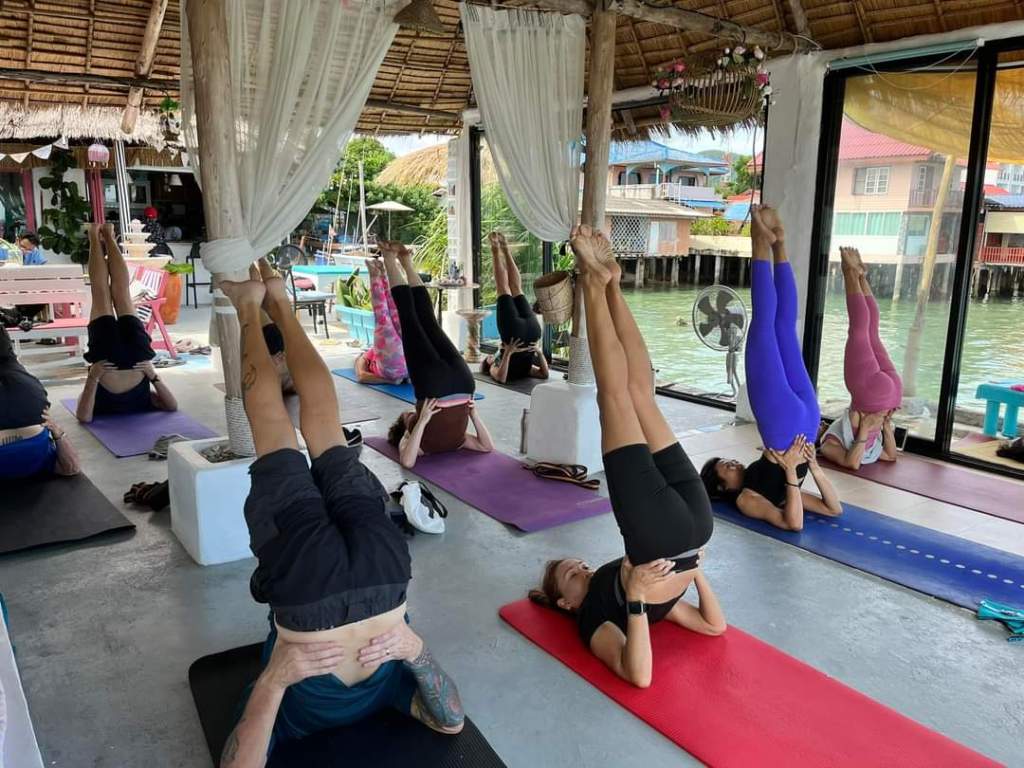
I thought I’d include one of my photos here, the yoga class I attend in my new location. Several of these yogis also attend my pilates group, which I established in my home.

In my opinion, this is one of the most important steps to settling a new location: building a community. It is important to remember, however, that this doesn’t come about in one day (there are exceptions to the rule, as in fact, my first community here was established on my ‘first’ day alone in the new location, over coffee). Usually this process takes days, or weeks, or even months. When I lived in Taiwan, it was a year before I established close friends and a network. However, if you keep your focus on first establishing this for yourself, and then your family (often the two are combined), this is a sure way of supporting your adjustment and mental-health.

Getting involved in the school

“When things settled down at school and you feel you have the time, ask yourself what could be done to improve the school, department, or your year group…opportunities to develop ideas support your own professional development, [and] they will make you feel more ‘useful’ or part of the running of the school.” (Gosling, 2021, p.98).

Getting involved in the community

“Supporting the community in which you live can be hugely rewarding and it is a way you can make a difference. Consider doing some voluntary work and/or check whether the school runs any community support projects through your buddy, the school, or the wider community.” (p.99)

“You may also identify a potential need for a certain activity within your community, such as a specific sport. Connect with other teachers and the wider community to see if there is any interest, effectively widening your social sphere. If the activity is sport, contact the PE teachers to see if the school grounds and equipment could be used.” (p.99).

Persuing other interests

“…[With increased work-life balance many international schools offer] this is an opportune time to try recreational pursuits such as cycling, golf, climbing, amateur dramatics, or singing in a choir. There may also be additional opportunities to work, such as modelling, tutoring, or developing your own business.” (p.101).

It is important to be open to opportunities which present themselves, as well as thinking about what you could start. Joining Facebook groups in your local area will often post events.

August 2024 Update: Two weeks into my relocation, I have taken it (for me) quite slow. I am looking for ways to integrate into the community.

So far I have followed my hobbies, yoga and pilates, which I mentioned before. Furthermore I have been open to connections from my husband’s workplace, and will meet with a part-time teacher next week. Also linked to the school, I am meeting with the Parents Association representative to see where I can be a help. I have investigated learning Thai, but at this point have not taken on a teacher as I’m enjoying my time being flexible, but have now received audio lessons which I will aim to practice at least every other day. I am joining a book club this weekend and I am considering establishing one myself, to swap books. We are looking to join the next beach cleanup, as it is a recurring problem here.

I am open to all new opportunities that come my way, and am mindful of things I can do to empower the community.

Settling in: Part 3 Building your home

With the rush and busyness of the first few days, which roll into weeks, it’s easy to lose sight of yourself and your needs. This can be compounded if you are also settling in your family to a new location, home and school.

In my book I highlight small changes you can make to ensure you are more comfortable in the first few weeks of the move.

“If you have a fully-furnished apartment [or house], add your own touches, even if it is just with small decorative items…contact your buddy or support groups to find out the best places to purchase household items. Many schools set this up as part of their induction programme.

A great option is to find second-hand items through classifieds placed on Google+ groups, Facebook groups, or via staff who are selling their belongings. Make your apartment feel at home as quickly as you can.” (Gosling, 2021, p.97).

August 2024 update: So what did I do? I indeed personalised my home! I bought in a floor mat for resting on, beanbag for the same reason. Being a huge fan of coffee, I bought my own machine. I investigated the local area and found a great second-hand book shop and am slowly building my collection up again. I also invested in a yoga mat and knee pads to continue with yoga and pilates. I hadn’t brought may items to personalise the property yet, but I will in time. I want to make sure I am secure here before bringing all my nik-naks across with me. My daughter brought with her all her familiar squishees and stationary and her room looks very personalised to her.

Early on I visited a thrift store to pick up some basics at cheap cut prices. I asked around where others had bought their electric items.

What did you do to make your ‘home’?

Settling in: Part 2 – Missing loved ones

You’ve moved across the world: new home, new workplace, new environment. Initially it can feel really exciting. You may make connections quickly or not. Either way, it’s likely that sooner or later you will miss your loved ones: family, old friends and even ex-colleagues.

I am in week 2 of my move, less than a week in my current home. When my husband and daughter left for school that is when the feeling of needing to connect to people I already new became apparent. Here is an excerpt from my book, Becoming a Successful International Teacher (2021):

“Homesickness is likely to affect you at some point after your move. One teacher described it thus:

Wherever you go, it is human nature to compare it to where you have been before but this is not helpful. I began to miss the things I could only get in the UK and these became very special when I could find them in shops. Once I started to embrace the new things in the country, it really started to feel more like home.’

This can be a difficult period, therefore connect with your family and close friends quickly to help counteract this. Set up the internet within your apartment as soon as possible. As stressed previously, you can connect via a platform you like to use and can access in your new country, such as Skype or Facetime. Knowing that family and loved ones are a quick call away can be hugely reassuring” pp.96-97.

Update August 24: So what did I do? I reconnected with first friends who are now in my timezone. Some of these friends I hadn’t spoken to, with a phone call, for over a year due to working full-time. I also re-connected with an ex-colleague who caught me up on the developments at my old ‘home’. I have set weekly calls (and bi-weekly) for a family member, which will keep the contact up and stop my missing my close relationships so much. I will also ensure that my daughter has regular contact with her family, to keep those bonds strong.

What have you done to connect with loved ones?

Settling in: Part 1

Overwhelmed/disorientated/unsure/uncomfortable…normal feelings at the start of the move!

It can be the most disorientating and overwhelming feeling to be taking on a new job, in a new country, and finding a new home. This is my first year of stepping down from joining an international school, to help my family relocate. However, the feelings of disorientation are somewhat matched, except I do not have a class to be responsible for. Instead, I have been better able to support my family with the stress of a new job for my partner, and a new school for my daughter.

Over the upcoming weeks, I will blog and post here about ways to settle in. This is an area that can be very much overlooked with a move, but it is so important for your mental well-being. I will share my thoughts plus excerpts from my book, Becoming a Successful International Teacher (2021).

“When you first arrive, you may worry that you will not meet friends with similar interests. It’s important to remember that you don’t need to only be friends with fellow teachers; both expats and locals in the outside community can be fantastic for helping you integrate and feel settled.

In order to develop a social network, join clubs which interest you and establish friends outside of work. To find these clubs, contact your school buddy or post on local Facebook groups and other social media. While taking precautions to stay safe, you may also wish to post that you are new to the area and ask if anyone would like to meet up and show you around.

If you have children, seek out parent groups. That way you can socialise with others who have common interests and at the same time, the kids will be entertained.

Another great resource is ‘InterNations’, an expat organisation that is active in most countries. They often host networking events. These meetups are either free to join, or charge a small fee. They can easily be found with an internet search.” pp.95-96.

My update, August 2024

This year I have settled in a small seaside town. From joining Facebook groups I could see that there was a yoga group operating once per week where I live. Also on this feed, I saw someone was looking for pilates. The issue was that there wasn’t a venue. I connected with the yoga/pilates teacher on SM and arranged a meetup to create a new group. We shared coffee and conversation, and I offered my small garden for the group class. One of the group members drove me home and pointed out different areas of interest in the town. It turns out she is a neighbour. After some anxiety this morning due to several reasons, getting out on the first day and meeting others did me good.

Subsequent Relocation: Is it any easier?

For those of you heading towards the departure date, how do you feel?

I am now on my sixth overseas relocation (seven if you count a stint in California as a student). But I’ve got to say, except for knowing what to take with me and put in place before I go, the feeling of uncertainty remains and in fact is almost exasperated by having other experiences to relate back to.

There are certain assurances which have helped hold back the nerves. This time, when I relocate my family abroad, find a new house, start my child in a new school, I will not be working in the school.

I can in fact put our relocation as my top priority.

Whilst my husband has begun to think about working on planning for the first term, I have been thinking of ways to best settle my daughter. A further assurance has been great communication from the school: I know there is a ‘new starters’ day for my daughter, for example. On a practical sense, the school are kindly collecting us from the airport directly following our flight. In addition, we have received an outline of our entire schedule with the lead up to the new term, so I know what to expect.

On a recent trip out of the UK I observed just how much my family thrived having new experiences in new places. The trip I had not researched well (in part to my detriment as we almost missed our flight home – warning to anyone using Milan Bergamo airport!) but, all went well and it felt like an adventure. Observing my family so happy with this trip made me realise that we need change and a new chapter in our lives.

However, there I still worry about the unknown.

Will we like our new location as much as we love the country as a holiday destination?

Is it somewhere we can thrive as a family: with connections, activities and in the workplace/school?

I can not answer these questions yet and although I find this next move (in my forties) more mentally taxing than I did when I was younger, I also know that I need this new chapter to expand and grow.

My prep is almost done so there has to be a point when I am fully packed (for a comprehensive list on what to do/pack you can check out my book). In my last few days leading up to the relocation I am concentrating on being kind to myself and my family. I will embrace all that the UK has to offer, knowing it will be a while before I am back. If this means a couple of days rest before the big move, enjoying crumpets and British TV on the couch, then so be it!

If you are soon to relocate, how will you be kind to yourself?

Preparing for Relocation: again

“The only thing that really worries me at the minute is the flight”, my daughter shared with me this morning.

Always the problem-solver, this was easily rectified by showing her the aircraft walk through and entertainment choices. Now she is excited.

But with 16 days left to fly, my worries are very different. I will speak about these to a greater extent in future blogs, but one way I eliminate worries is to prepare and organise as much as I can, to make life easier on ‘the other side’.

I cover a whole chapter on Preparations in my guide, however, I’ll let you know what I have been organising this summer.

  1. I have created one file with ALL my paperwork: certificates, passport photos, contracts, letters of work evidence, glass prescriptions, bank information, etc.
  2. Completed all necessary appointments for my whole family: doctors, dentists and eye checks. Currently trialling contact lenses which are more suitable for the Asian climate.
  3. Shredded all out-of-date paperwork. As we have lived abroad for almost 15 years, this has mounted up! To make space we have cleared everything more than 10 years old.
  4. Booked first accommodation and arranged (with the school) airport pick-up. We will arrive after a long haul flight but decided the best thing for us would be to head directly to the beach to relax.
  5. Arranged car hire for after our first short hotel stay.
  6. Bought all necessary products – shampoo/conditioners for my curly hair, sunscreen we like, moisturiser and make up, contact lenses, medications.
  7. Purchased necessary clothing – smart outfits for initial inset meet and greet, swimsuits and rash tops, a few light pieces of summer clothing (for all). Water shoes and work shoes.
  8. Considering an epilator (can I take the pain?!)

    To do: Arrange playdate for my daughter with children from her class. Contact estate agents to book in viewings. Book in Typhoid vaccinations in Thailand (to pay privately in the UK costs a fortune!)

[Insert country here] is not for everyone

I have just completed a two year teaching placement in Warsaw, Poland. As Europe is often seen as a ‘top’ international destination, why did I chose to leave after completing my contract?

Simply, I never felt the country was a ‘good fit’ for me or my family.

Having spent more than a decade in Asia, I realised early on the grievances in Asia (distance from home being one) were nothing in comparison to living in a country in which you feel a lack of connection.

However, I do not regret the move, even though it has caused some hardships.

Moving from Asia to Europe ‘scratched the itch’ which I had always felt. Professionally, I was able to try leadership, which was a great step.

Leading up to the move, I was becoming irritable often whilst in Asia, and instead of embracing experiences I was rejecting them. After twelve years, I no longer felt ‘in-love’ with the continent and I often found fault with most things. I dreamed of order. I wanted facilities, such as pavements, road safety, reliable electricity sources, and hot water in a sink.

However when I came to Poland I had a huge feeling of discontent. Everything was quite normal and functional, but at the same time (for me), no challenge. I believe I had reverse culture shock. The country was too similar to where I had been born, the UK. Sure it was cheaper and certainly more advanced in terms of apps for everything (buses, banks, purchases), but it did not excite me.

The weather was dismal. I was used to sunshine most if not every day of the year. In Poland I was lucky to have this three months of the year (as every summer I left).

The language was difficult and the area in which I lived, an international area, had very little to offer in terms of classes or groups for those from other countries. I tried to set up community groups and a book club which included all nationalities, including locals, yet I only connected with two people. The book club fizzled out quickly on my part, as I had no interest for it. I think I was struggling at this point which made it all the more difficult. I attended yoga class for a while, but as a Brazillian classmate explained, we found the experience challenging and not relaxing,  as my Polish was slow to progress.

Moreover, as the majority of the school staff were married to Polish partners, there was not the  community I had been used to in previous placements. Teachers often went home to their extended family whilst younger staff had interests which did not match mine.

In both Asia and Africa, I have been used to the school staff becoming your family. I am not saying that I was without connections, as I made several life-long connections. However, establishing a strong, large community with teachers and non-teachers, from all nationalities, including the host country, is important to me.

But perhaps more than any other reason for the move back to Asia, was that it wasn’t an adventure for me.

I have realised that I can not live somewhere for others.

As a family our reasons to live in a country can not be solely based on proximity to the UK. Ultimately, my decision to return to Europe had been Covid-led. The guilt I felt of being unable to travel home in three years was the most dominant factor. In the desire to be close to loved ones I ignored the recommendations of my own book, to be clear on why exactly I wanted to choose Poland as a place to live.

So when others ask, why are you moving from Europe? My answer will remain…it is not home.

Make sure you consider deeply the country in which you will live and make sure it aligns with a place you will feel comfortable, settled, and most importantly, joyful.

First quarter of 2023: A time to reflect and learn

First and foremost, a quick shout out to teachers now starting their Easter break! I hope you enjoy a peaceful and well-deserved rest. If you are moving abroad this year, take the time to check out my chapters on prior preparation before the move, and how to adjust to your new location. Believe me, it will come quickly! And if you are still seeking a job, don’t give up! Be aware Europe is still advertising, my school has just re-advertised for jobs.

So what have I been doing? I must say this has been a quiet few months for me. I have continued to write for TES, but not at the same frequency as I was last year. I thought about my why for this slowing down and taking stock. I realise that a lot has happened in these past 6 months. A new school, new home, new country, and a return to something which was once familiar, but now is alien. I have alluded to reverse culture-shock previously, but this is something I have really identified with my adaptation here in Europe. Everything is quite like England.

Yet, I have begun to build my network, starting a book club of complete strangers (!) which turned out to be great. A complete mix of age and nationalities, all with different and interesting jobs. I’ve developed my unit too, arriving with few basic resources to now, a well-resourced unit with open-ended materials and challenging toys. As my confidence has grown so has my wish to continue to improve where I work, and I have created action plans to this end which are being well-considered.

I have also taken this ‘quiet’ period as one in which to learn. I have been following conferences and webinars. I feel after writing so much and presenting at conferences, it is extremely important to return to learning in a intentional way. I have enjoyed learning so much from other’s experiences, including experts. Through following webinars I have made new connections also for my #PLN.

I wonder if others follow this cycle, knowingly. Teaching then learning, a back and forth which ensures we all grow. Let me know if this is what you do.

Moving from a large international school to a one-form entry

This was a recent article I produced for the TES. It discusses my shock at the change, but how I have learnt to adapt and found many positives in working within a small school. I hope it may help some readers in the same position.

2023: Seeking and Responding to Surprises

I thought I’d start with this image: more than 100 locks of love secured and promised.

How often do we promise ourselves something, which reflects our love for ourselves? I’m guessing, if you are like me, practically never!

This picture was just one I snapped as I walked around Gdansk, this Christmas break. Here is another.

Both pictures show to me what I have always held true with travel, you can turn a corner and find something completely different, a new surprise. The first I happened upon as I was seeking a vegetarian lunch and the second was ‘amber’ street, discovered as I walked into the old town.

These surprises are delightful and I find more often than not, I enjoy them more than my original destination. There is a feeling of ‘discovery’ about them.

Which made me reflect again, what surprises have I had that have shown me a way forward to something different and exciting?

Well, at the end of 2022 I was offered several training, presenting and writing experiences. They seemed come all at once, as these things do. Instead of wondering how I would do them, especially the live (!) ones, I simply accepted. And this Christmas break I have been working on them.

I made sure I chose times that would work for my family and other commitments; but working in the evening, on a long train or car journey, stimulated me in these different areas and has made me think of other goals I want from my life.

2023, I promise will be a ‘yes’ year to new experiences, to more writing and presenting. I will seek these experiences as well as connect with others in educational content writing. Loving myself enough to believe I deserve these experiences and quite frankly, rock them, is what I will continue to remind myself.

In 2023, what new surprises will you seek? Will you be open to change?